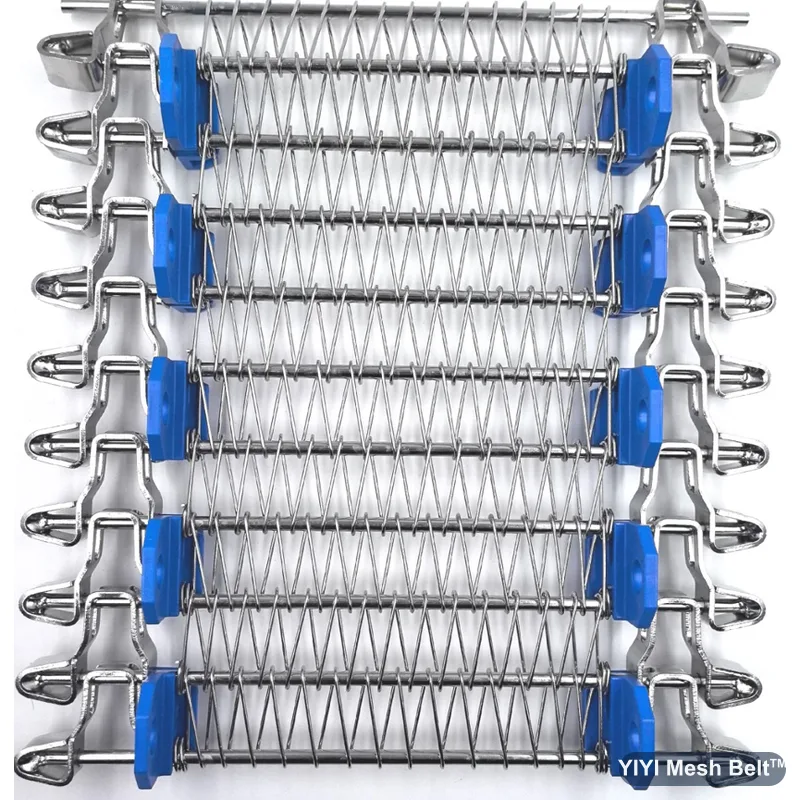
A wire mesh conveyor belt is a metal conveyor belt built from stainless or carbon steel wire, rods and links, used where a product must be frozen, baked, fried, washed or cooled while it moves. YIYI Mesh Belt builds 11 belt types to your approved drawing or sample.
Choose by process or belt structure. Every belt is built to your approved drawing, with a first article confirmed before production.
Send Your Drawing WhatsAppEach flagship belt is checked against the approved drawing before packing; spiral freezer, self-stacking and side driven belts are drum-tested on every order.

An engineered metal conveyor belt for spiral and turning conveyor systems.

An engineered belt for self-supporting, self-stacking conveyor systems.

An open metal conveyor belt made of eye-shaped links joined by cross rods.

A structured wire conveyor belt selected by pitch, wire diameter, space count, width and edge.
Spiral, open-structure, woven and chain belts, plus matching sprockets.

A spiral freezer belt built for a 1.1 turn ratio, a small-radius geometry that supports compact spiral systems.
SPIRALA side-driven, side-guided spiral belt where the drive works on the belt edge.

A flat-strip metal conveyor belt connected by cross rods, with a flat carrying surface and an open honeycomb structure.

A woven metal conveyor belt built from alternating left- and right-hand spirals joined by crimp wires, so the belt tracks straight.

A dense woven metal conveyor belt for continuous conveying where the product needs close support.

A project-specific bakery and oven belt family. Material, pitch, wire, rod, width and edge are confirmed from the actual belt, an old sample or your approved drawing.

A mesh belt carried and driven by side chains.

A conveyor of steel plates carried on rods and chains.

Stainless and polymer sprockets matched to your belt pitch; bore, keyway and teeth confirmed on drawing. Made by specialist partners to our specification; YIYI checks the finished parts.
No belt listed for this process yet — send your drawing and we will review it.
Reference ranges from our technical specifications. The approved drawing sets the final values.
| Belt type | Typical processes | Belt width | Key dimension |
|---|---|---|---|
| Spiral Freezer Belt | Freezing, cooling, spiral baking, frying | 300–2900 mm | Turn ratio 1.10–2.5 |
| Spiral Freezer Belt (Small Turning Radius) | Compact spiral freezing and cooling | 300–1200 mm | Turn ratio 1.1 |
| Self-Stacking Belt | Spiral freezing, cooling, proofing | 420–760 mm | Guard 60–120 mm |
| Side Driven Belt | Spiral and curved conveying, freezing, cooling | 300–1100 mm | Turn ratio 1.63 |
| Eye Link Belt | Washing, drying, meat & seafood, heavy-duty | 300–3000 mm | Rod pitch 25.4–76.2 mm |
| Flat Wire / Honeycomb Belt | Baking, cooling, drying, washing | 200–4000 mm | Rod pitch 12.7–50.8 mm |
| Trapezoidal Mesh Belt | Frying, coating, custom conveyors | 76–2352 mm | Pitch 4–23.8 mm |
| Balanced Weave Belt | Baking, heat treatment, general conveying | 200–5000 mm | Spiral pitch 2.8–40 mm |
| Compound Weave Belt | Small products, close conveying surface | 200–3000 mm | Pitch 6–20 mm |
| Biscuit Belt | Baking, oven lines | Project-specific | Confirmed on drawing or old belt |
| Chain Driven Belt | Heat treatment, parts washing, heavy-duty | 300–5000 mm | Chain pitch 12.7–63.5 mm |
| Chain Plate / Plate Link Belt | Heavy-duty, solid surface conveying | 300–4000 mm | Plate pitch 25.4–63.5 mm |
| Application | Belt types we build for it |
|---|---|
| Freezing | Spiral Freezer, Self-Stacking, Side Driven, Small Radius Spiral |
| Cooling | Spiral Freezer, Self-Stacking, Side Driven, Small Radius Spiral, Flat Wire / Honeycomb |
| Proofing | Self-Stacking |
| Baking & oven | Spiral Freezer, Flat Wire / Honeycomb, Balanced Weave |
| Frying | Spiral Freezer, Chain Driven, Trapezoidal Mesh |
| Coating and enrobing | Trapezoidal Mesh |
| Snack lines | Trapezoidal Mesh, Flat Wire / Honeycomb, Balanced Weave |
| Meat and seafood | Eye Link |
| Washing and drying | Eye Link, Flat Wire / Honeycomb, Chain Driven |
| Blanching and pasteurizing | Eye Link, Flat Wire / Honeycomb, Chain Driven |
| Heat treatment | Balanced Weave, Chain Driven |
| Can washing | Balanced Weave, Compound Weave |
| Glass annealing | Balanced Weave, Compound Weave |
| Small products | Compound Weave |
| Heavy-duty conveying | Eye Link, Chain Driven, Chain Plate |
Suitability depends on belt specification, temperature and equipment design. We confirm it during specification review.
| Material | Belt types |
|---|---|
| SUS304 / SUS316 | Spiral, self-stacking, side driven, eye link, flat wire, chain driven, chain plate, balanced weave, compound weave and trapezoidal belts |
| SUS316L | Flat Wire / Honeycomb |
| Mild steel | Eye Link, Flat Wire / Honeycomb, Chain Plate, Balanced Weave, Compound Weave |
| Carbon steel | Chain Driven |
We draw stainless wire and round bar in-house, and every incoming batch is checked by spectral and hardness testing.
A quotation depends on the belt, not on a price list. These are the details we confirm first:
Send a drawing or photos of your current belt. We reply as soon as we see your message, within 8 working hours.
Start from your process and product: temperature, product size, load and how the belt is driven. Then confirm width, pitch, material and edge on a drawing. Our engineers review this before quoting.
Yes, after review. Send the drawing, the current belt or a sample, and we confirm geometry and drive relationship before production.
SUS304 and SUS316 stainless steel, and mild or carbon steel for selected belt types. Every incoming batch is checked by spectral and hardness testing.
Yes. Each belt type has a technical specification in mm and inch on the Downloads page.
Yes. Third-party inspection is supported on request, and customer factory visits are welcome.
A wire mesh conveyor belt is a metal conveyor belt built from stainless or carbon steel wire, rods and links, used where a product must be frozen, baked, fried, washed or cooled while it moves. YIYI Mesh Belt builds 11 belt types to your approved drawing or sample.
New equipment, replacement or spare; product type and application; belt width and length; pitch; wire and rod diameter; material; edge type and drive; quantity; and your drawing or photos of the current belt.
Buyers often ask for a mill test report (MTR) or mill test certificate (MTC). Each incoming batch of wire and rod is checked against steel-mill material documentation, with spectral and hardness testing. Tell us which documents your order needs and we confirm them in the quotation. Read more about material documentation.
Send your drawing, a photo or a worn sample. An engineer reviews it before we quote.
We reply as soon as we see your message, within 8 working hours · No obligation · Your details are used only to reply to you.